Key Takeaways
- Online reputation management (ORM) covers monitoring, content suppression, review management, proactive brand building, and crisis response — the exact mix depends on whether your situation is proactive maintenance or active damage repair.
- Pricing runs $500–$10,000+ per month for most businesses, with the single biggest cost driver being whether the work is proactive or reactive — a live crisis costs significantly more than steady-state maintenance.
- Google Search remains the most critical platform for ORM since what appears on page one of search results for your name or brand is typically the first thing a prospective customer or employer checks.
- Corporate share prices fall by an average of 35.2% after a reputational crisis and can take well over a year to recover — making proactive reputation management one of the clearer cases for treating marketing spend as insurance rather than discretionary.
- The most important distinction between ORM providers: suppression (pushing negative content down) versus removal (actually getting content taken down) — these are different services with different success rates and very different promises to be skeptical of.
What Does Online Reputation Management Do?
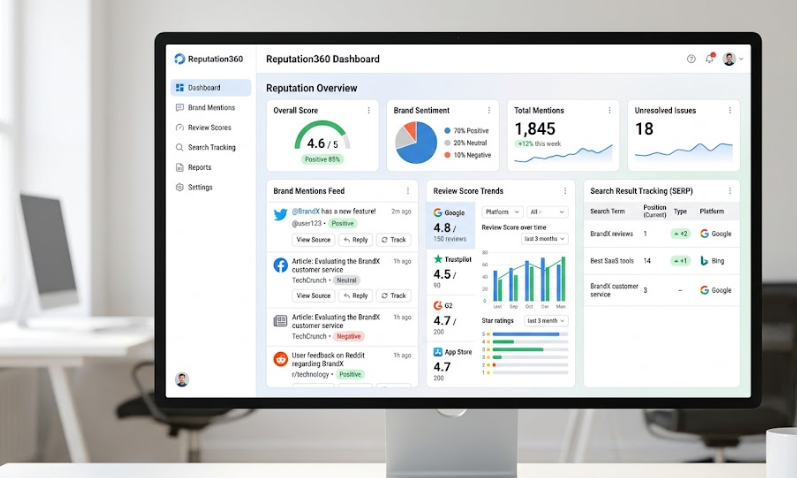
Online reputation management is the ongoing process of monitoring, shaping, and protecting what appears when someone searches for your name, brand, or business online. It combines several distinct service categories that often get bundled under one label:
Monitoring — tracking mentions of your brand across search results, review platforms, social media, news sites, and forums to catch reputation threats before they compound.
Review management — generating new positive reviews, responding to existing reviews (both positive and negative), and managing your profile across Google, Yelp, Trustpilot, and industry-specific platforms.
Search result suppression — creating and promoting positive content (articles, profiles, press coverage, social media pages) that ranks above negative content on page one of Google results, effectively pushing harmful URLs down.
Content removal — attempting to have negative content actually deleted through legal channels, platform policies, or deindexing requests — a higher bar than suppression and rarely guaranteed.
Crisis response — rapid, coordinated action when a damaging story, review, or social media incident reaches mainstream visibility, requiring 24/7 monitoring, counter-messaging, and stakeholder communication.
Why It Matters Right Now
Corporate share prices fall by an average of 35.2% after a reputational crisis, and it can take well over a year to recover to pre-crisis levels. For small and mid-sized businesses without shareholders, the equivalent damage shows up in lost leads, cancelled contracts, and customer churn — often without the business understanding why until the pattern is already established. The real online reputation management cost is usually service fees plus pass-through hard costs. Understanding what you’re actually buying before signing anything is what separates a useful investment from an expensive promise.
What Is the Best Online Reputation Management Company?
There isn’t one universal answer — the best provider depends on whether you need monitoring and maintenance, active review management, search result suppression, or crisis response, since these are meaningfully different service types requiring different expertise.
A few names that consistently appear at the top of independent rankings:
NetReputation — frequently cited as a top-rated provider for individuals and small businesses needing search result cleanup and review management, with plans across a range of budget levels.
WebiMax — often recommended for businesses facing more serious reputation challenges, with capabilities spanning content removal, search suppression, and PR-driven positive content creation.
Reputation.com — particularly well-regarded for multi-location businesses and enterprises managing review programs across large numbers of locations simultaneously.
Birdeye — strong reputation specifically for review generation and management software, suited to businesses primarily focused on building review velocity rather than search result suppression.
For any specific situation, evaluating providers against your actual need (maintenance versus repair versus crisis) produces a more reliable shortlist than any general “best of” ranking.
Which Platform Is Best for Online Reputation?
Google Search is the most important platform for most businesses and individuals, since your search results, reviews, and news mentions keep changing and page one of Google for your name or brand is the first thing most prospective customers, partners, or employers check. Google Business Profile reviews carry particular weight for local businesses, since star ratings appear directly in Google Maps and local search results without a click required.
Beyond Google, which platform matters most depends on your business type:
Google Business Profile — critical for any local business where customers make decisions based on reviews and star ratings.
Yelp — essential for restaurants, local services, and healthcare where Yelp reviews often rank on page one of search results independently.
Glassdoor — increasingly important for employers, since negative employer reviews directly affect recruiting and can appear in searches for company names.
Trustpilot and industry-specific platforms — more relevant for SaaS, financial services, and professional services where buyers specifically research these platforms before purchasing.
Social media (Meta, LinkedIn, X/Twitter) — important for brand monitoring and rapid response to public complaints, but generally less durable in search results than review platform content or news coverage.
A critical 2026 consideration worth noting: whether AI citation surfaces (Google AI Mode, Perplexity, ChatGPT) are also surfacing negative content has become a new and distinct ORM challenge — negative content that appears in AI-generated answers reaches users who never scroll to traditional search results, making AI platform coverage a newer but growing part of a complete reputation management strategy.
How Much Does Online Reputation Management Cost?
Pricing breaks down most cleanly by situation type rather than business size alone:
Proactive maintenance (monitoring + review management)
Small businesses and individuals can expect to pay $500 to $2,500 per month for reputation management services, including simple monitoring and response management. On average, individuals and small businesses will pay between $550 and $2,500 per month.
Active reputation repair (suppression of negative search results)
Mid-sized companies or businesses with specific reputation challenges typically invest $2,500–$10,000 per month, covering expanded monitoring, content creation, and active search result suppression campaigns.
Crisis response
$8,500–$25,000 depending on severity and required speed, including 24/7 crisis monitoring, rapid suppression, counter-messaging, and stakeholder communication.
One-time repair projects
Based on DesignRush portfolio data from 2024-2025, the average cost of reputation management typically falls between $5,000 and $100,000, with higher-risk or high-profile cases exceeding that range.
The single biggest pricing driver across all of these is whether the work is proactive or reactive. Low-risk, proactive reputation management — monitoring, review management, and brand building — costs significantly less because it is predictable and planned. High-risk or crisis-driven reputation management requires rapid response, senior-level involvement, and often 24/7 availability, which increases pricing.
How Much Does Online Reputation Repair Cost?
Reputation repair — actively working to suppress or remove existing negative content from search results — is distinctly more expensive than maintenance, since it involves creating and ranking enough positive content to displace what’s already there, which can be a slow and resource-intensive process.
A few honest things to know before engaging any ORM provider for repair work:
Suppression and removal are different things. Regular reputation agencies focus on suppression tactics to bury negative content. Legal strategies aim for actual removal. Suppression pushes content down in search results; removal actually gets it deleted. Most providers offer suppression; true removal is less common, harder to guarantee, and typically more expensive.
Timeline matters to price. The faster you need results, the more resources need to run in parallel, which pushes cost up. A 6-month suppression campaign costs less than a 30-day emergency response targeting the same content.
The authority of the negative content drives difficulty. A negative Reddit comment is easier to suppress than front-page news coverage or a high-authority review site post. Providers who quote the same price regardless of source authority are either underestimating the work or over-promising results.
How to Evaluate an Online Reputation Management Company: Step-by-Step
- Define your situation accurately before contacting anyone. Monitoring and maintenance, active suppression, removal, or crisis response each call for different capabilities — and different budgets.
- Ask specifically whether they offer suppression or removal. If they promise removal without explaining the mechanism (legal, platform policy, deindexing), treat the claim skeptically.
- Request case studies from situations similar to yours. A provider experienced in personal name repair may not have the right capabilities for a corporate brand crisis.
- Confirm what’s included beyond the monthly fee. The real online reputation management cost is usually service fees plus pass-through hard costs. PR placements, legal fees, and content production may be billed separately even when not stated upfront.
- Ask for reporting tied to search result position, not just activity. Monthly reports should show movement in actual search rankings for relevant queries, not just content published or monitoring alerts sent.
Common Mistakes When Hiring an ORM Company
- Waiting for a crisis before engaging — proactive reputation management costs a fraction of crisis response, and the lead time required to build positive content means reactive-only approaches are always playing catch-up.
- Confusing suppression with removal — a provider who promises to “remove” content without explaining exactly how is almost certainly describing suppression, not deletion.
- Choosing based on lowest monthly fee without asking what’s excluded — pass-through costs for content creation, PR placements, and legal review can double the effective monthly cost.
- Ignoring AI search platforms as a reputation surface — negative content appearing in Google AI Mode, Perplexity, or ChatGPT answers reaches users who may never see traditional search results.
- Expecting fast results from search suppression — ranking positive content above entrenched negative content takes time, and any provider promising dramatic results in weeks deserves scrutiny.
Wrapping Up
Online reputation management is most cost-effective as a proactive, ongoing program rather than an emergency response — the gap between maintenance pricing and crisis pricing is wide enough that it’s worth treating ORM as a standing investment rather than a reactive expense. Before engaging any provider, know whether you need monitoring, suppression, removal, or crisis support — these are different services with different capabilities, timelines, and costs, and conflating them is the fastest route to expensive disappointment.
Frequently Asked Questions
What is the best online reputation management company?
There’s no single universal answer — the best provider depends on your situation. NetReputation is frequently cited for individuals and small businesses, WebiMax for more serious suppression challenges, Reputation.com for multi-location enterprise review management, and Birdeye for review generation specifically.
How much does online reputation repair cost?
Active reputation repair — suppressing existing negative search results through content creation and SEO — typically runs $2,500–$10,000 per month depending on the authority of the negative content and the timeline required. Crisis response engagements with 24/7 coverage run $8,500–$25,000+ depending on severity and speed requirements.
What does online reputation management do?
ORM monitors brand mentions across search, review platforms, and social media; generates and manages reviews; creates and promotes positive content to suppress negative search results; attempts content removal through legal or platform channels where possible; and coordinates rapid response during reputation crises.
Which platform is best for online reputation?
Google Search and Google Business Profile are the most important platforms for most businesses since page-one results and star ratings are the first thing most people check. Beyond Google, the highest-priority platform depends on business type — Yelp for local services, Glassdoor for employers, and Trustpilot for SaaS and professional services.
How much does online reputation management cost?
Proactive maintenance typically runs $500–$2,500/month for individuals and small businesses. Active repair campaigns run $2,500–$10,000/month. Crisis response runs $8,500–$25,000+ depending on severity. The single biggest pricing driver is whether the work is proactive or reactive.
About the Author