Key Takeaways
- An ecommerce marketing agency combines SEO, paid ads, email marketing, and conversion optimization specifically for online stores — distinct from a general digital marketing agency that serves all business types.
- The top five ecommerce websites in the Philippines by traffic in mid-2026 are Shopee, Lazada, Amazon, Temu, and Carousell — a mix of dominant regional platforms and global entrants.
- The best agency for any specific ecommerce store depends more on channel specialization and platform experience than on agency size or general reputation.
- Digital marketing in ecommerce covers the full customer acquisition and retention cycle — search, social, email, paid, and content — all pointed at driving profitable sales rather than general brand awareness.
- The four types of ecommerce are B2C (business to consumer), B2B (business to business), C2C (consumer to consumer), and D2C (direct to consumer), each calling for meaningfully different marketing approaches.
What Is an Ecommerce Marketing Agency?
An ecommerce marketing agency is a specialist firm that designs, executes, and optimizes digital marketing strategies specifically for online stores — combining SEO, paid search and social advertising, email and SMS marketing, conversion rate optimization, and content strategy under one roof, all oriented toward driving product sales rather than general leads or brand awareness. This distinguishes them from general digital marketing agencies, which typically serve all business types and may not have deep platform-specific expertise in Shopify, WooCommerce, or marketplace-specific advertising on platforms like Shopee and Lazada.
The specialist distinction matters because ecommerce marketing has specific mechanics that general marketing skills don’t automatically transfer to — product feed optimization for Google Shopping, abandoned cart email sequences, marketplace ranking algorithms, and catalog-level SEO all require experience that most generalist agencies don’t have.
What Is Digital Marketing in Ecommerce?
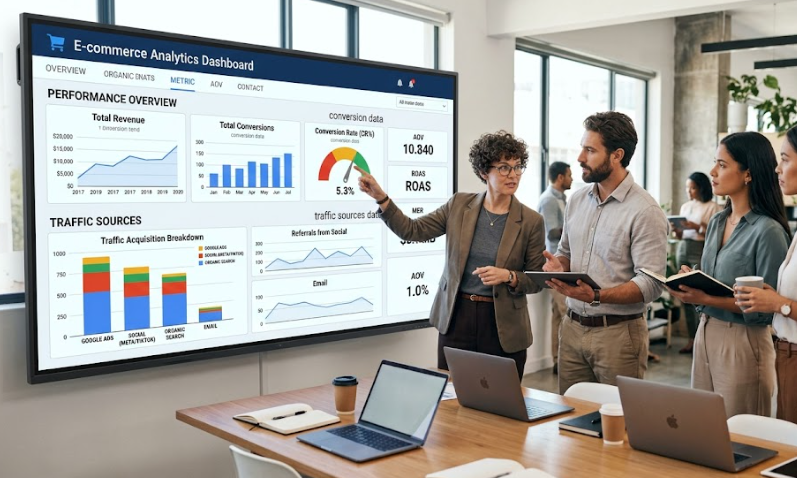
Digital marketing in ecommerce covers the complete customer acquisition and retention cycle — every channel and tactic used to bring a potential buyer to a store, convince them to purchase, and bring them back again. The core channels include:
Organic Search (SEO) — optimizing product pages, collection pages, and blog content to rank in Google for purchase-intent keywords, generating traffic without ongoing ad spend.
Paid Search and Shopping — Google Ads, Google Shopping feeds, and Bing Ads targeting buyers actively searching for specific products, with direct product imagery and pricing in the ad unit.
Paid Social — Meta, TikTok, and Pinterest advertising using interest and behavioral targeting to reach potential buyers who haven’t searched yet but match the store’s customer profile.
Email and SMS — automated sequences (welcome series, abandoned cart, post-purchase) and campaign-based broadcasts to existing customers, typically the highest-ROI channel per dollar spent for established stores.
Marketplace Marketing — advertising and optimization on Shopee, Lazada, and other regional platforms where sponsored listings, flash sale participation, and seller metrics all directly affect organic visibility.
What Are the Top 5 Ecommerce Companies in the Philippines?
Based on current traffic data for June 2026, the top five ecommerce shopping websites in the Philippines are Shopee, Lazada, Amazon, Temu, and Carousell, with Shopee ranking first and Lazada second as the leaders of the ecommerce and shopping category.
The Philippines ecommerce market is dominated by regional C2C and B2C platforms, with Shopee and Lazada commanding the largest share. Specialized retailers like Zalora for fashion, Datablitz for gaming, and BeautyMNL for cosmetics serve specific categories, while global brands including Adidas and Nike operate direct channels alongside local electronics retailer Abenson, reflecting a diverse marketplace serving 115+ million consumers increasingly shopping online.
For Philippine ecommerce businesses specifically, the platform mix matters for marketing strategy: the ecommerce market is dominated by regional C2C and B2C platforms with distinct advertising systems and ranking algorithms, meaning an agency with Shopee and Lazada advertising experience serves Philippine sellers differently than one with only Google and Meta expertise.
What Are the 4 Types of Ecommerce?
Understanding which type of ecommerce a business operates tells you which marketing approaches are most relevant — the four types call for meaningfully different channel mixes and messaging strategies.
B2C (Business to Consumer)
The most common ecommerce model — a business sells products directly to individual consumers. Most Shopee and Lazada sellers, branded Shopify stores, and direct-to-consumer brands operate under this model.
B2B (Business to Business)
A business sells products or services to other businesses, typically in larger volumes. Marketing emphasis shifts from impulse and conversion triggers to relationship-building, specification-level content, and longer sales cycles.
C2C (Consumer to Consumer)
Individual consumers sell to other individual consumers through platforms like Carousell or Facebook Marketplace. The platform itself does most of the marketing infrastructure work; individual sellers compete on price, photos, and reviews.
D2C (Direct to Consumer)
A brand manufactures and sells directly to consumers, bypassing retail intermediaries. D2C marketing typically emphasizes brand building, email and SMS retention, and owned-channel traffic rather than marketplace dependency.
Which Digital Marketing Agency Is Best for Ecommerce?
There’s no single best agency — the right fit depends on which channels are most valuable for your specific store, which platform you sell on, and how far along your revenue growth is. A few practical filters that matter more than agency size or name recognition:
Platform specialization — an agency that primarily works with Shopify merchants has different expertise than one optimized for Shopee and Lazada marketplace growth. Match the agency’s core platform experience to where you actually sell.
Channel depth vs. breadth — some agencies are genuine specialists in paid social or SEO; others claim to cover every channel without depth in any. Identify which one or two channels are your highest-leverage growth levers and prioritize agencies with a proven track record there.
Ecommerce-specific case studies — results from service businesses or lead generation clients don’t automatically transfer to product-based ecommerce. Ask specifically for ecommerce revenue, ROAS, and conversion rate outcomes, not just traffic or impressions.
Reporting transparency — a good ecommerce agency connects marketing activity to revenue, not just clicks. If a prospective agency can’t clearly explain how they attribute sales to specific channels, that’s a gap worth probing before signing.
How to Choose a Digital Marketing Agency for Ecommerce: Step-by-Step
- Define your primary growth lever first. If organic traffic is your biggest gap, an SEO-specialist agency serves you better than a full-service generalist; if you’re traffic-rich but converting poorly, CRO expertise matters more.
- Match platform expertise to your actual sales channels. Philippine marketplace sellers need Shopee and Lazada-specific experience; Shopify merchants need expertise in the Shopify ecosystem.
- Ask for ecommerce-specific case studies with revenue metrics. Traffic wins from service-business clients don’t validate ecommerce capability.
- Confirm reporting structure before signing. You should receive regular reporting that connects agency work to actual revenue and profit metrics, not just engagement or impressions.
- Clarify contract terms around channel ownership. Confirm that ad account access, data, and assets stay with you if the relationship ends — not with the agency.
Common Mistakes When Hiring an Ecommerce Marketing Agency
- Hiring a generalist agency because they’re cheaper — ecommerce has specific technical requirements (product feeds, catalog SEO, cart abandonment flows) that generalist skills don’t automatically cover.
- Choosing based on follower count or award badges alone — neither predicts whether an agency can drive product sales in your specific market and platform mix.
- Skipping the contract ownership question — losing access to your ad accounts or data when changing agencies is a costly and avoidable problem.
- Expecting fast results from SEO and slow results from paid — the channel timelines work the other way: paid ads produce results quickly but require ongoing spend, while SEO takes longer to build but compounds over time.
- Treating Philippine marketplace marketing as interchangeable with global channel expertise — Shopee and Lazada have distinct advertising systems, ranking algorithms, and seller metric requirements that require platform-specific knowledge to navigate effectively.
Wrapping Up
A digital marketing agency genuinely suited to ecommerce does more than run ads and write blog posts — it understands the specific mechanics of product discovery, conversion, and retention that separate online stores from other business types. Matching the agency’s platform expertise and channel depth to your actual business situation, rather than choosing on price or brand name alone, is the most reliable way to find one that connects marketing spend to actual revenue growth.
Frequently Asked Questions
What is an ecommerce marketing agency?
An ecommerce marketing agency is a specialist firm that designs and executes digital marketing strategies specifically for online stores — combining SEO, paid ads, email, and conversion optimization oriented toward driving product sales, rather than general leads or brand awareness.
What are the top 5 ecommerce companies in the Philippines?
Based on mid-2026 traffic data, the top five ecommerce shopping websites in the Philippines are Shopee, Lazada, Amazon, Temu, and Carousell, with Shopee and Lazada commanding the largest share of the local market.
Which agency is best for digital marketing?
There’s no universal answer — the right agency depends on your platform, your primary growth channels, and where your revenue is currently constrained. Platform specialization and ecommerce-specific revenue case studies are more reliable selection criteria than agency size or general reputation.
What is digital marketing in ecommerce?
It’s the complete customer acquisition and retention cycle for an online store — SEO, paid search and shopping, paid social, email and SMS, and marketplace marketing — all oriented toward driving profitable sales rather than general brand awareness.
What are the 4 types of ecommerce?
B2C (business to consumer), B2B (business to business), C2C (consumer to consumer), and D2C (direct to consumer) — each requiring meaningfully different marketing approaches, channel priorities, and messaging strategies.
About the Author